

Trailer Hitch Weight Chart: Complete Guide to Classes, Capacity & Towing Limits (2026)

Last Updated: June 2026 | By Geteen Team
Choosing the right trailer hitch isn't just about fitting your receiver — it's about safety. The wrong hitch class can lead to dangerous towing situations, equipment damage, or even accidents. This trailer hitch weight chart gives you everything you need to match your vehicle, trailer, and towing needs to the correct hitch class.
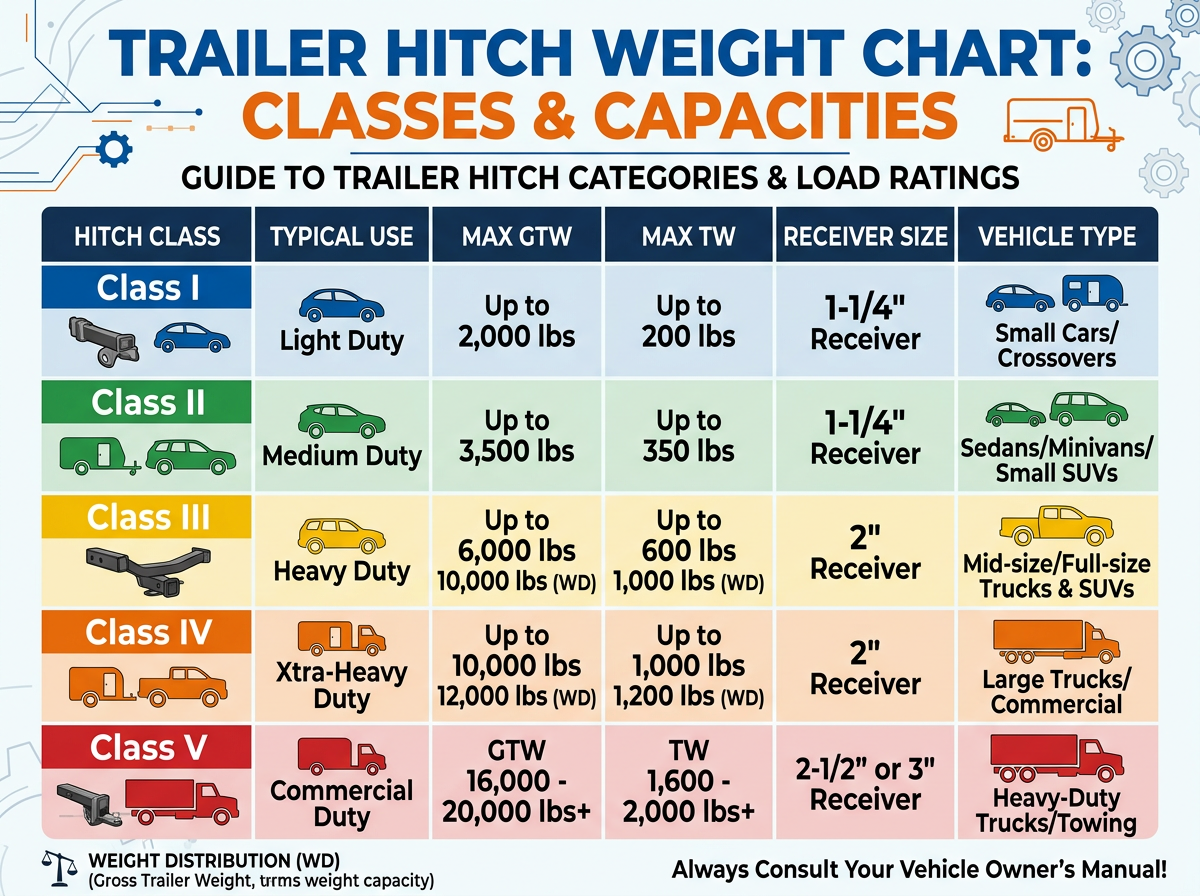
Quick Reference: Trailer Hitch Weight Chart
| Hitch Class | Receiver Size | Max Tongue Weight | Max Towing Capacity | Common Use |
|---|---|---|---|---|
| Class I | 1-1/4" | 200 lbs | 2,000 lbs | Small trailers, bike racks |
| Class II | 1-1/4" | 350 lbs | 3,500 lbs | Small boats, utility trailers |
| Class III | 2" | 500 lbs | 5,000 lbs | Mid-size campers, cargo trailers |
| Class IV | 2" | 1,000 lbs | 10,000 lbs | Large campers, construction trailers |
| Class V | 2" or 2-1/2" | 1,500+ lbs | 12,000+ lbs | Heavy-duty hauling, large RVs |
Key Takeaway: Always choose a hitch class rated at or above your trailer's loaded weight. Never exceed your vehicle's maximum towing capacity, even if the hitch is rated higher.
What Do Trailer Hitch Classes Mean?
Trailer hitch classes are standardized ratings that tell you how much weight a hitch can safely handle. There are five main classes, each designed for different towing needs.
Class I Hitch (Light-Duty)
- Receiver Size: 1-1/4" x 1-1/4"
- Max Tongue Weight: 200 lbs
- Max Towing Capacity: 2,000 lbs
- Best For: Small utility trailers, bike racks, cargo carriers
Class I hitches are ideal for compact cars and small SUVs. They're perfect for light loads like bike racks or small utility trailers. If you're just starting with towing, this is the entry point.
Class II Hitch (Medium-Duty)
- Receiver Size: 1-1/4" x 1-1/4"
- Max Tongue Weight: 350 lbs
- Max Towing Capacity: 3,500 lbs
- Best For: Small boats, jet ski trailers, lightweight utility trailers
Class II hitches work well for mid-size sedans and smaller SUVs. They can handle small boats and lightweight camping trailers with ease.
Class III Hitch (Standard-Duty)
- Receiver Size: 2" x 2"
- Max Tongue Weight: 500 lbs
- Max Towing Capacity: 5,000 lbs
- Best For: Mid-size campers, cargo trailers, horse trailers
Class III is the most popular hitch class for recreational towing. It's the sweet spot for most SUV and pickup truck owners who tow camping trailers or medium-sized cargo loads.
Pro Tip: Many Class III hitches, like Geteen's adjustable trailer hitches, feature a 2" receiver with dual-ball or tri-ball configurations, making them versatile for different trailer coupler sizes.
Class IV Hitch (Heavy-Duty)
- Receiver Size: 2" x 2"
- Max Tongue Weight: 1,000 lbs
- Max Towing Capacity: 10,000 lbs
- Best For: Large campers, construction equipment trailers, large boats
Class IV hitches are built for full-size trucks and large SUVs. If you're towing construction equipment or large RV trailers, this is your minimum requirement.
Class V Hitch (Extra Heavy-Duty)
- Receiver Size: 2" or 2-1/2" x 2-1/2"
- Max Tongue Weight: 1,500+ lbs
- Max Towing Capacity: 12,000+ lbs
- Best For: Large RVs, heavy construction trailers, commercial hauling
Class V hitches are for serious towing. They're commonly found on heavy-duty pickup trucks and commercial vehicles. Geteen's 2-1/2" receiver hitches are designed for these heavy-duty applications, with towing capacities up to 15,000 lbs.
Understanding Tongue Weight vs. Towing Capacity
Many people confuse these two critical measurements. Here's the difference:
| Term | Definition | Why It Matters |
|---|---|---|
| Tongue Weight | The downward force the trailer tongue exerts on the hitch | Too little = trailer sway. Too much = poor steering. |
| Towing Capacity | The total weight the hitch can pull | Exceeding this can damage your vehicle's frame, transmission, or brakes. |
| Gross Trailer Weight (GTW) | The total weight of the trailer when fully loaded | This is what you compare to towing capacity. |
The 10-15% Rule
Your tongue weight should be 10-15% of your gross trailer weight. For example:
- Trailer weight: 5,000 lbs
- Ideal tongue weight: 500-750 lbs
- Required hitch class: Class III or IV
If your tongue weight is too low, the trailer will sway. If it's too high, your vehicle's front end will lift, making steering dangerous.
How to Choose the Right Hitch Class for Your Vehicle
Step 1: Check Your Vehicle's Towing Capacity
Your vehicle's maximum towing capacity is listed in:
- Owner's manual
- Driver's side door jamb sticker
- Manufacturer's website
Never exceed this number, even if your hitch is rated higher.
Step 2: Calculate Your Trailer's Loaded Weight
Add up:
- Trailer's dry weight (from manufacturer)
- Cargo weight
- Water weight (if applicable)
- Propane tanks (if applicable)
- Gear and supplies
Step 3: Match to Hitch Class
| Your Trailer's Loaded Weight | Minimum Hitch Class | Recommended |
|---|---|---|
| Under 2,000 lbs | Class I | Class I |
| 2,000 - 3,500 lbs | Class II | Class II |
| 3,500 - 5,000 lbs | Class III | Class III |
| 5,000 - 10,000 lbs | Class IV | Class IV |
| Over 10,000 lbs | Class V | Class V |
Step 4: Consider an Adjustable Hitch
If you tow different trailers, an adjustable trailer hitch with multiple ball sizes saves you from buying multiple hitches. Geteen's dual-ball and tri-ball hitches fit both 2" and 2-1/2" receivers with interchangeable ball configurations.
Trailer Hitch Receiver Size Guide
The receiver is the square tube mounted under your vehicle. The hitch slides into it.
| Receiver Size | Hitch Classes | Vehicle Types | Common Uses |
|---|---|---|---|
| 1-1/4" x 1-1/4" | Class I, II | Compact cars, small SUVs | Bike racks, light trailers |
| 2" x 2" | Class III, IV | Full-size SUVs, trucks | Campers, cargo, boats |
| 2-1/2" x 2-1/2" | Class V | Heavy-duty trucks | Large RVs, commercial |
Important: The receiver size must match your hitch. You can use a reducer sleeve to fit a smaller hitch into a larger receiver, but never the other way around.
Common Towing Scenarios & Recommended Hitches
Camping & RV Towing
| Scenario | Trailer Weight | Recommended Hitch | Geteen Product |
|---|---|---|---|
| Small pop-up camper | 1,500-3,000 lbs | Class II or III | Dual Ball for 2" Receiver |
| Mid-size travel trailer | 3,500-7,000 lbs | Class III or IV | Adjustable Dual Ball |
| Large fifth-wheel RV | 10,000+ lbs | Class V | Heavy-Duty 2-1/2" Receiver |
Construction & Heavy Hauling
| Scenario | Trailer Weight | Recommended Hitch | Geteen Product |
|---|---|---|---|
| Utility trailer with tools | 2,000-4,000 lbs | Class III | Tri-Ball for 2" Receiver |
| Equipment trailer | 5,000-10,000 lbs | Class IV | Heavy-Duty Aluminum Hitch |
| Flatbed with machinery | 10,000+ lbs | Class V | 2-1/2" Receiver Hitch |
Everyday Towing
| Scenario | Trailer Weight | Recommended Hitch | Geteen Product |
|---|---|---|---|
| Bike rack | Under 500 lbs | Class I | Any Class I hitch |
| Small boat | 1,500-3,000 lbs | Class II or III | Dual Ball for 2" Receiver |
| Cargo carrier | Under 500 lbs | Class I or II | Any Class I/II hitch |
Frequently Asked Questions (FAQ)
What happens if I use a hitch that's too small for my trailer?
Using an undersized hitch is extremely dangerous. It can cause:
- Hitch failure and trailer detachment
- Loss of vehicle control
- Damage to your vehicle's frame
- Accidents that endanger you and others
Always match or exceed your trailer's weight with the appropriate hitch class.
Can I use a Class III hitch on a Class II receiver?
No. The hitch and receiver must be the same size. A Class III hitch (2" receiver) won't fit into a Class II receiver (1-1/4"). You can use a reducer sleeve to fit a Class II hitch into a Class III receiver, but never the reverse.
How do I know my tongue weight?
You can measure tongue weight with:
- Tongue weight scale — Most accurate method
- Bathroom scale method — For trailers under 300 lbs tongue weight
- Weigh station — For heavy trailers
- CAT scale — Available at many truck stops
What's the difference between a fixed and adjustable hitch?
- Fixed hitch: One ball height, one ball size. Simple but less versatile.
- Adjustable hitch: Multiple height positions and ball sizes. More versatile for different trailers.
If you tow multiple trailers, an adjustable trailer hitch is the better investment.
Do I need a weight distribution hitch?
Weight distribution hitches are recommended when:
- Your trailer weighs more than 50% of your vehicle's weight
- You experience trailer sway
- Your vehicle's rear end sags when towing
They redistribute tongue weight across all axles, improving stability and steering.
How often should I inspect my hitch?
Inspect your hitch:
- Before every trip: Check for cracks, rust, loose bolts
- Monthly: Lubricate moving parts, check pin and clip
- Annually: Full inspection, check wiring, replace worn parts
Geteen Trailer Hitch Product Line
Geteen manufactures adjustable trailer hitch ball mounts designed for strength, stability, and easy towing. Our hitches feature:
- ✅ Drop-forged construction for maximum strength
- ✅ Powder-coated finish for rust resistance
- ✅ Anti-rattle gasket for smooth, quiet towing
- ✅ Locking hitch pin for theft deterrence
- ✅ Dual-ball and tri-ball configurations for versatility
- ✅ 10,000-15,000 lb towing capacity depending on model
Browse our complete product line:
Shop Now →